


We were intending to share a different post this week, but instead we’d like to encourage everyone who hasn’t already to read 32-year-old Olympic athlete Beth Dobbin’s experience with severe ME in this BBC article from 16th October (contains video).
Those that are affected by ME will know how much this interview may have cost Beth. We are incredibly grateful to her for choosing to use her platform to speak out so clearly about how badly ME can affect your life and how little support there is.
Something we talk about often is that it can be hard, if you haven’t experienced it, to understand just how horrific ME can be at the severe end of the scale. We think Beth did a great job of expressing this: “It feels like you are a few days from death.”
It’s an excellent piece of reporting from Katie Falkingham, who accurately represents the nature of the disease, the scale of the issue, how many are affected, and the range in severity:
“More than 400,000 people in the UK are thought to have ME, although the true figure could exceed one million, with severity ranging from people able to work or study to those requiring round-the-clock care and tube feeding.”
Beth’s family are also quoted in this article, and as carers ourselves, we can totally relate to her sister Faye’s concern:
“I’m always worried about Beth. She’s always on my mind. I’m worried about what kind of day she is having. What if she never improves? What if she gets worse? What if she gets another virus?”
What can you do for someone with ME? Her mum Jean’s comments echo our reasons for setting up ThereForME:
“There is nothing out there. There is nowhere to go. You go to the GP and there’s nowhere for them to send you to. It’s really at the back of the queue as far as research, knowledge, expertise, funding.”
BBC Look North ran a segment featuring Beth’s interview on the same day. (With thanks to Adam @BrokenBattery for clipping it.)
Since the article was published, we have been so pleased to see it picked up by lots of other news outlets, in the UK and internationally.
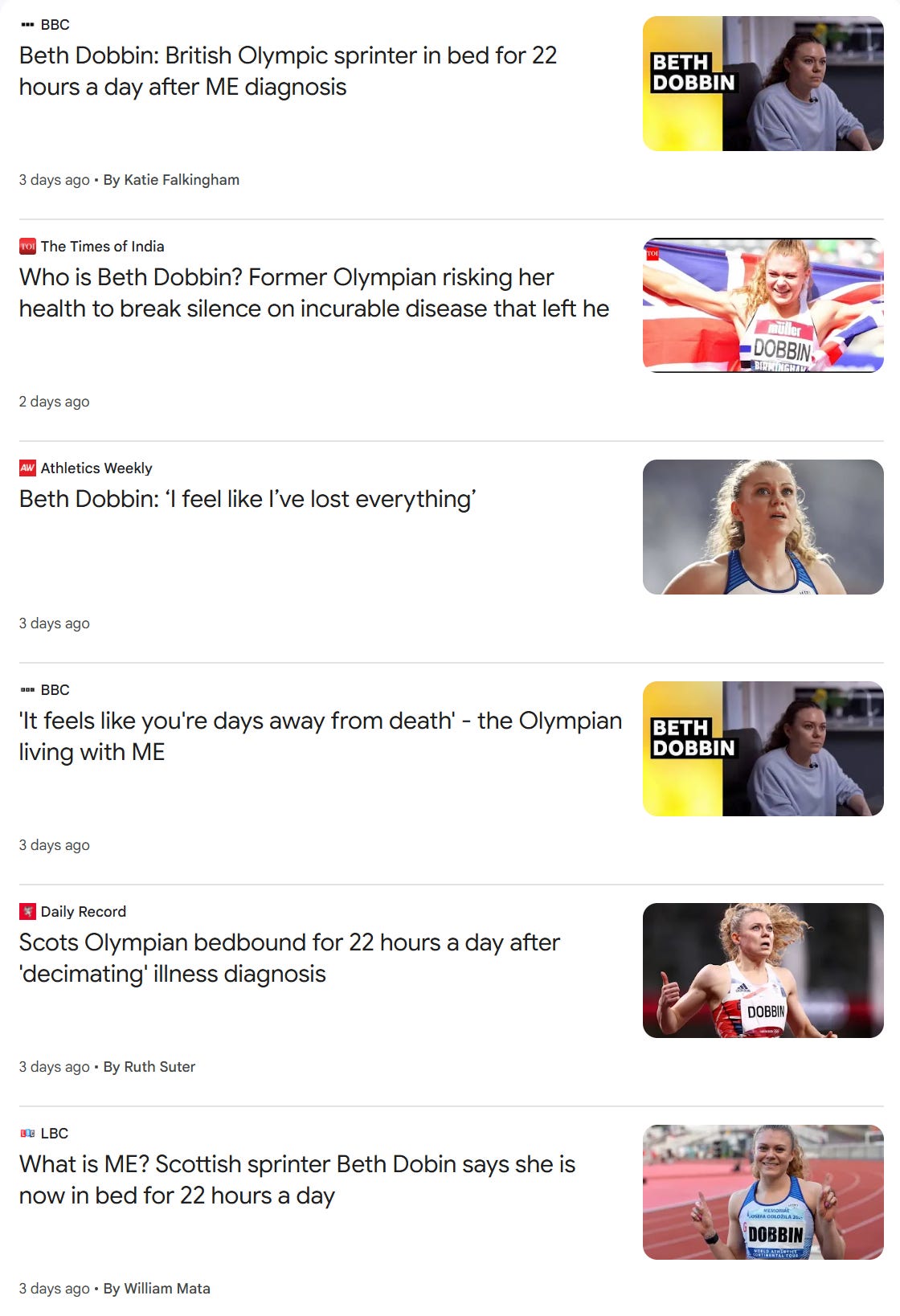
Experts respond
ME experts Dr Binita Kane and Dr Charles Shepherd both spoke to the BBC about Beth’s experience, highlighting the lack of support for people with ME and the absence of any treatment targeting the underlying disease.
5 Live’s Drive programme that day (16th October) also featured clips from Beth’s interview, and Dr Binita Kane (ThereForME’s medical ambassador and founder of the Long Covid Clinic) was interviewed by Clare McDonnell. (With thanks to Adam @BrokenBattery for clipping this.)
She reiterated the risk that Beth took in speaking out, and described the state of research - “We probably understand a lot more about it now than we have at any point in time” - but pointed out that there is a “huge gaping hole in how people like Beth get support.”
BBC Radio Sheffield ran a segment on Beth’s story yesterday, with guest Dr Charles Shepherd of the ME Association. Listen here (from 2h 11m).
Dr Shepherd drew attention to the importance of early diagnosis, and spoke about research being conducted by the ME Association to understand the similarities between ME and Long Covid.
Asked about treatment, he said: “We have these poor figures on outlook and prognosis, [which] relates very much to the fact we do not have a treatment for this illness. We don’t have a drug treatment which is aimed at the underlying disease process which is going to make people better.”
The impact of Beth’s efforts is not to be underestimated. Raising awareness of what severe forms of ME are like is key to changing how systems respond. As we said in our recent letter to the Guardian, the government’s Delivery Plan for ME contains clear gaps and we are calling for scrutiny from the Health and Social Care Select Committee.
Thank you to everyone involved in making this story visible.
Thoughts go out to Beth during her illness journey, a story many of us can relate to.
I thought the BBC did quite a good piece on it in comparison to other media outlets, and it's an unfortunate reality that Athletes and other high achievers battling this disease does further the cause.