


It’s been a while since our last update. Some of you may have noticed that we’ve been a little quiet lately - we’ve been working on a little something behind the scenes which we are looking forward to being able to share with you. As you’ll know, we’re a small team and in our second year of #ThereForME we’ve been considering what the future holds and how we can make our work more sustainable amidst our busy lives. More on this soon.
Today, we’re bringing you the latest updates from Westminster, as well as our favourite recent spots from the research world and wider Substack community. If you’re feeling the January blues, you’re not alone. We hope there’s some news in here which might help lift your spirits.
What’s happening in Westminster?
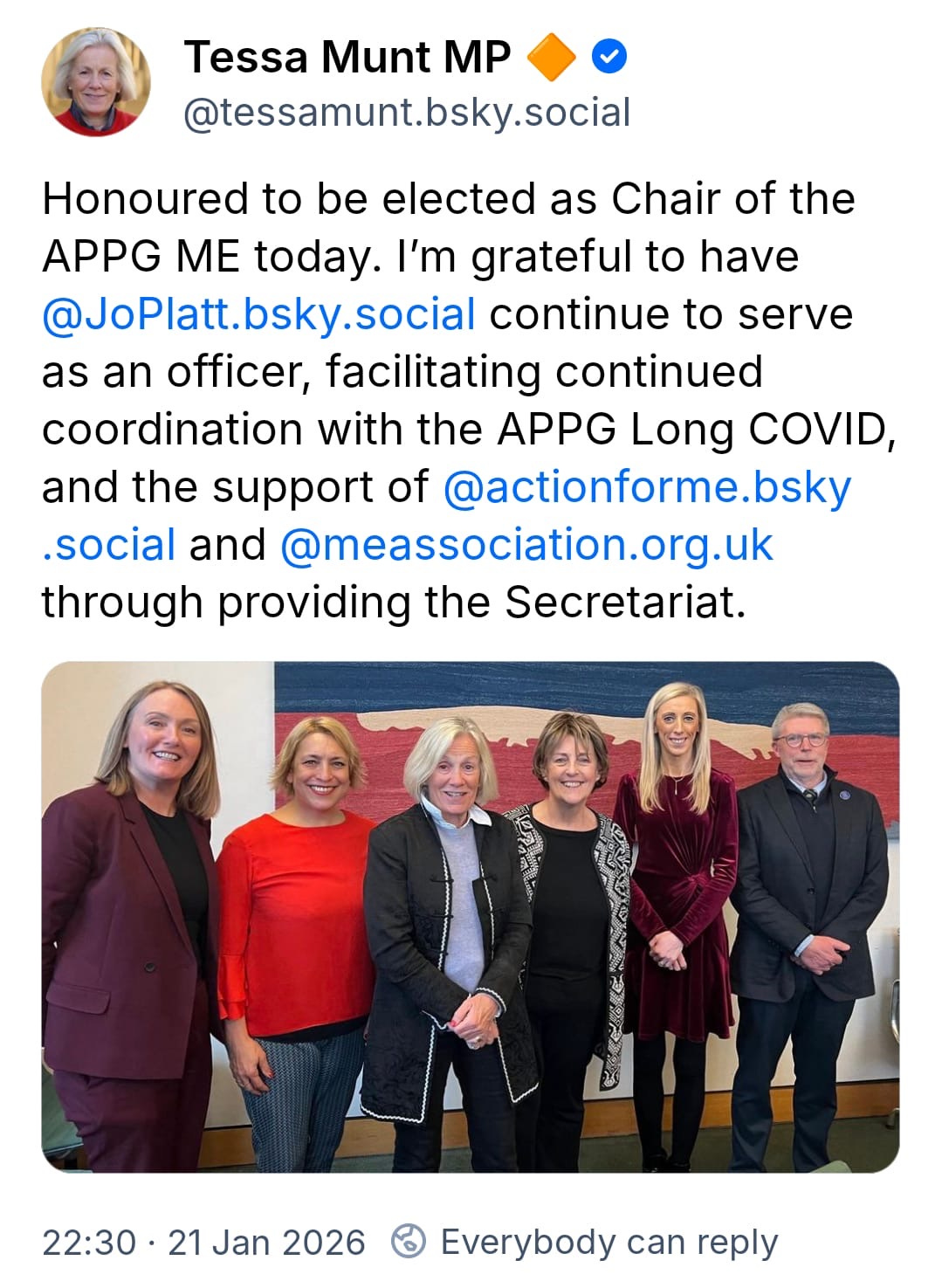
Last week, friend of #ThereForME and fierce champion for people with ME Tessa Munt was appointed as the new Chair of the APPG on ME. Jo Platt, who stood down as Chair, will remain as Vice Chair and will be a key link to the APPG on Long Covid (which she also chairs). A big thanks to Jo for her tenure as Chair and congratulations to Tessa on her new appointment! We’re looking forward to continuing to work with Tessa in her new role.
Elsewhere in Whitehall, DHSC is due to convene a meeting in February to discuss a new NHS template service specification for mild and moderate ME. The new service specification is part of the Final Delivery Plan for ME, which states that the specification will “fully take into account NICE guidelines on ME/CFS” and will “be disseminated to all integrated care boards (ICBs) to inform their commissioning decisions and support quality of local service provision to match local needs”. Dr Binita Kane will be representing #ThereForME as part of the discussion.
Though we’re pleased to see Delivery Plan actions on mild and moderate ME moving forwards, the question remains: why are the needs of the sickest patients being neglected? With patients across the UK facing life-threatening complications and all too common patient safety concerns, the case for urgent action to improve care for these groups couldn’t be clearer. A couple of weeks ago, a question raised in parliament by Labour MP Rachael Maskell confirmed that discussions between DHSC and NHS England on the potential commissioning of a specialised service for very severe ME remain ongoing. A recent question from Jo Platt MP elicited a remark from Health Minister Ashley Dalton that DHSC is “taking specific steps to ensure that patients with severe and very severe ME/CFS are not overlooked”. As always, we’ll be working to hold DHSC to account on this one.
Recent progress in research
On the research side, we were pleased to see that ME Research UK has awarded funding to Prof. Chris Ponting at the University of Edinburgh for a new study investigating the use of blood-based markers to help in the diagnosis of ME/CFS.
The researchers plan to measure the levels of around 1,100 proteins in plasma samples from people with ME/CFS and control subjects, and use machine learning to classify the participants based on their diagnosis. The study builds on the team’s previous research, which identified over two hundred proteins whose blood levels differed significantly between people with ME and controls.

Across the pond, we spotted some promising recent findings from Todd Davenport and colleagues, who published a preprint from a study comparing physiologic responses in people living with ME and Long Covid using two-day cardiopulmonary exercise testing (CPET). Both groups showed a similar failure to recover after exertion, with a lack of meaningful differences between the two groups suggesting a shared bioenergetic pathophysiology. Interestingly, the study found that females showed more pronounced post-exertional abnormalities than males, and that the severe functional impairment shown in both groups was not explained by deconditioning.
A new substack on the block!
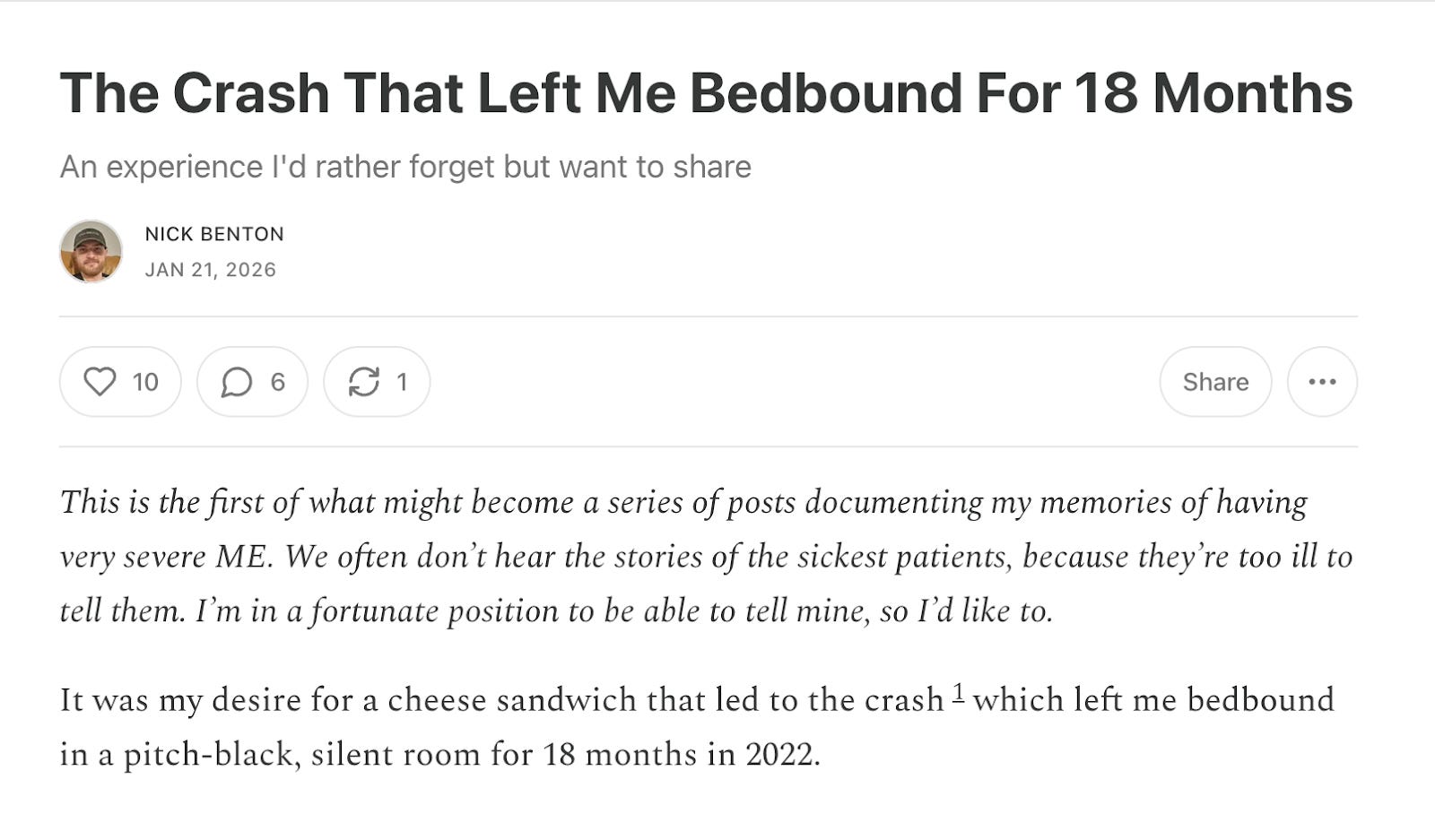
We were delighted to spot that former #ThereForME guest blogger Nick Benton has started a Substack of his very own. Nick’s substack, which he’s aiming to publish fortnightly, shares his experiences of ME. His latest blog post details the crash that left him bedbound for 18 months. If you’re looking for a new Substack to add to your collection, this one comes as a recommended read.
We’ll see you next week.
I get that you are trying to cheer us up. But it is extremely wry to see happy smiley faces when Savannah is starving in hospital. It's been 4.5 years since this happened to Maeve and nothing has fundamentally changed.
And none of those smiley faced people are doing anything to help her, even after they were asked specifically, even though they have the budget and the connections to be able to meaningfully help.
I don't want to celebrate them. I am utterly furious with them.
And I am hugely disappointed not to see you highlight that there's yet another woman with severe ME being starved by the NHS, especially as you highlight the lack of safe care for the severe in this update. Savannah asked us to email her hospital. You could have amplified that request.
You still can.
https://www.thecanary.co/uk/analysis/2026/01/22/severe-me-savannah/
Thanks for the update and all your brilliant work... really intrigued to find out what it is you've been working on