



In today’s update, we’ll take you through the latest updates on ME from the media, politics and research. But first, some news from ThereForME.
Following on from our recent news that we’ve registered as a charity, we’re pleased to announce that ThereForME is now on JustGiving. So, if you’re planning a charity challenge, event or birthday fundraiser, you can now select ThereForME as your cause.
We’ve even got a printable poster, an editable poster template, and an editable template for social media to help you publicise it.
We’d love to hear your fundraising plans. Let us know at hello@thereforme.org.uk.
ME (mis)represented in the press
On September 5th, the Telegraph published How having a disability became cool, a controversial article by Poppy Coburn, which specifically cited ME, Long Covid and POTS. We’ve chosen not to link to it because articles like this are designed to generate traffic through outrage. We were, however, glad to see GP and broadcaster Dr Amir Khan respond, drawing on 22 years in medicine to dismiss the article’s argument as “bollocks.”
Like many of you, we were happy to see George Monbiot return to the issue of ME in his opinion piece in the Guardian on 24th September - Abandoned, dismissed and gaslighted: there is no excuse for the way ME sufferers have been betrayed. Curious to find out if revised medical guidance on ME (specifically, the revised 2021 NICE Guideline) had led to any impact on clinical practice, he asked people to share their experiences. George writes:
“So what has changed as a result of these shifts? Alongside the horror and heartbreak in the testimonies of the people who emailed me, I was struck by the sense of sheer relief that someone, anyone, was asking the question. Many said they are still being treated as if they have a psychological illness, and still being pushed into GET and CBT [...] Patients report being treated with “contempt and derision.”
Days later, Monbiot appeared on LBC with Natasha Devon to discuss the issue. Natasha remarked:
“It’s hard to think of a community that is more invisible - because of the nature of the illness - more neglected, and more desperate to be heard.”
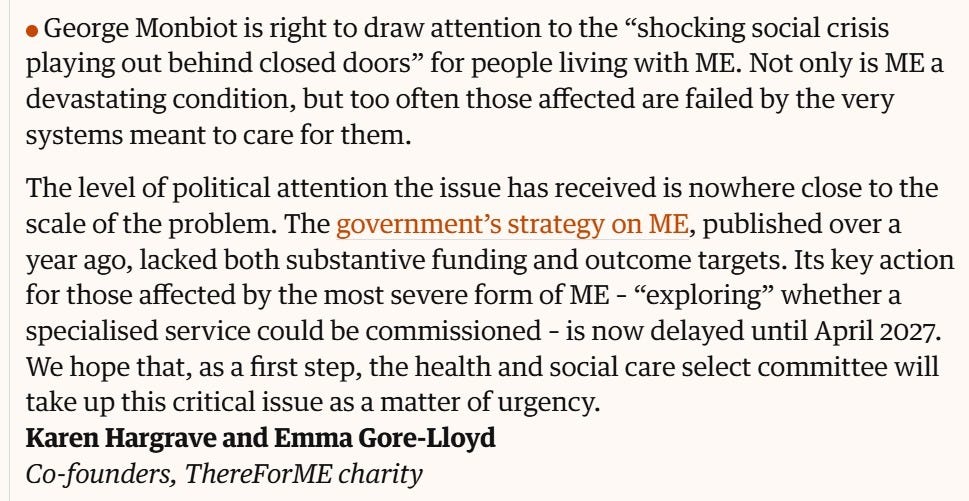
While of course none of this will be new to our subscribers, it’s a relief to see prominent figures like Monbiot and Devon standing in solidarity with people with ME and using their platform to bring this unseen crisis to a wider audience. The Guardian published our letter in response to Monbiot’s article, in which we highlighted the lack of political attention to ME, the clear weaknesses in the government’s response and called for scrutiny from the health and social care select committee.
Policy watch: Scotland and social care
Scotland’s implementation gap: The Scottish Parliament’s Health, Care and Support Committee met on September 2nd to discuss ME and Long Covid. The discussion highlighted the lack of specialist services, difficulties accessing appropriate care, harmful exercise advice, and calls for action rather than further strategy. Speakers in the discussion included #MEAction Scotland and Long Covid Scotland, who made powerful interventions. Stuart McIver (Long Covid Scotland) explained the gap in Scotland between existing frameworks and implementation:
“People with Long Covid have had their lives absolutely devastated and there’s very little help available for them. We’ve had a framework about a framework, about a strategic network, about an inquiry. People with Long Covid [in Scotland], our community, don’t need more policy work. They need implementation of what actually exists.”
National Care Service? Andy Burnham’s speech at the Labour Party conference last week made headlines - and (if you have the energy) it’s worth a watch in full. We were pleased to see Burnham continuing to emphasise his ambitions to overhaul social care, putting forward the idea of a national care service.
We’ve previously shared stories from members of the community who are struggling to get the social care support they or their loved ones need. We’re continuing to follow the national policy conversation on social care, and will be exploring alongside other partner organisations how we make sure the needs of those with ME and Long Covid are captured.
ME & Long Covid research
The HERITAGE study is recruiting participants: If you have had ME or Long Covid for two or more years and have not received specialist NHS care for it in the last 3 years, you may be able to take part.
The research team has informed us that participants need to provide their own answers and carers cannot complete questionnaires as proxy respondents without input from the participant. While they understand that this means some of those with the most severe forms of ME may not be able to take part, they hope to see participation from those who are able.
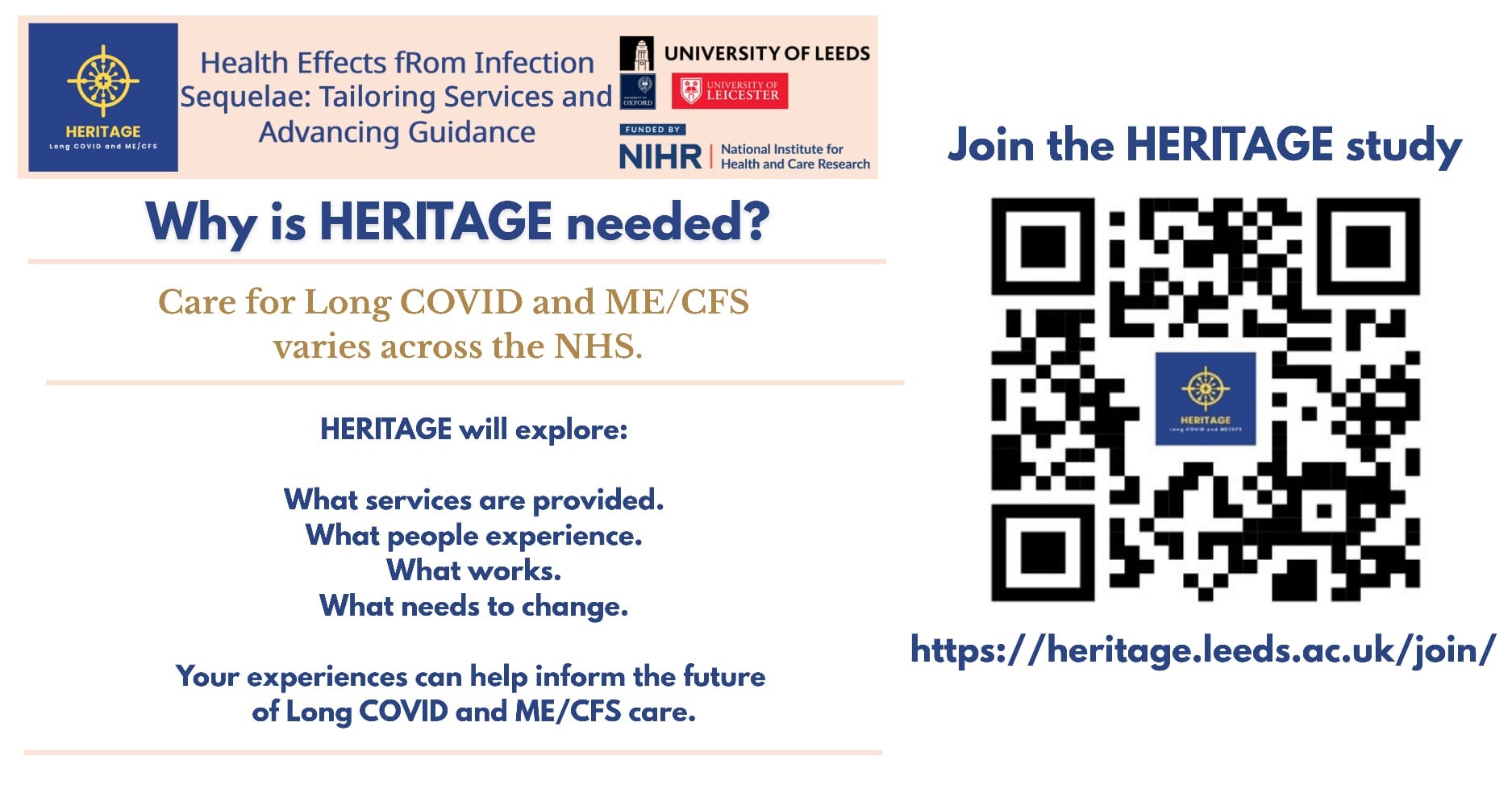
Find out more here: https://heritage.leeds.ac.uk/join/
(Please note that ThereForME is not affiliated with this study, and sharing this information does not imply an endorsement.)
PRIME International Symposium: The first PRIME International Symposium took place in Edinburgh and online on 28th–29th September, bringing together researchers, clinicians, industry, charities and people with lived experience of ME/CFS. PRIME is a Medical Research Council-funded project, led by the University of Edinburgh in partnership with Action for ME, that aims to build research capacity for ME in the UK.
Our co-founder Emma attended online. A highlight for her was a breakout discussion on how patient and public involvement (PPI) can improve the way research is designed. Other highlights included talks from early career researchers and preliminary findings from Action for ME's Big Survey. The sessions were recorded and will be made available for those unable to attend live.
If you want to catch their next live event, registration is currently open for the 4th PRIME Webinar: The Neurology of ME/CFS, which is scheduled for Wednesday, October 28, 2026 from 2:00 PM to 5:00 PM GMT online via Zoom
More to explore
Finally, a few more developments that caught our eye recently, from the UK and the wider world:
Our friends at Long Covid Kids have developed resources for children and parents, including an Individual Healthcare Plan (IHCP) template, available for download. It is intended to provide schools with information about the child’s needs for adjustments and support at school.
The British Association of Clinicians in ME/CFS (BACME) recently published a report from their Tube Feeding Survey. The report concludes with a list of recommendations including nutritional screening, development of standardised clinical guidance, and individualised ME-informed implementation.
Canadian podcast Conspirituality has a new episode out. Long Covid Profiteers looks at a current trial of the Lightning Process - which NICE Guideline 206 explicitly advises against offering to people with ME, and which has frequently been described as “neurobollocks”. (You can read our Oonagh’s experience with it in this 2024 Guardian article.)
Oscar-winning director Martin Strange-Hansen’s new film, Best Practice, stars Hjalte Ilsøe Gustavussen, whose sister suffers from severe ME. The 14-minute fictional film tells the story of the forced removal of a very severe ME patient from a home in Denmark by the authorities. The film is expected to be available within the next year.
That’s all from us for now. We’ll see you next time.