


Today’s guest post is from #ThereForME co-founder Karen Hargrave. Karen is a carer to her husband James, who lives with very severe ME.
For over a year now I’ve been struggling to secure NHS Continuing Healthcare (CHC) funding for my husband James. It’s been a gruelling process, emblematic of the many challenges people with ME face accessing support and ultimately getting the condition taken seriously by the NHS. Today I’m sharing our story, and why I think this is an issue that deserves decision-makers’ attention.
Our story
As regular readers of our Substack will know, my husband James developed ME following a Covid infection in 2022. His deterioration was rapid. Within a year he declined from being in near perfect health to spending 99% of his time in bed, in a darkened room, barely able to speak, chew or swallow. Today, close to four years on, he is totally bedbound. On a bad day (and there are plenty of them) he can hardly manage even non-verbal communication. His health is a constant source of stress, particularly the ongoing threat of malnutrition.
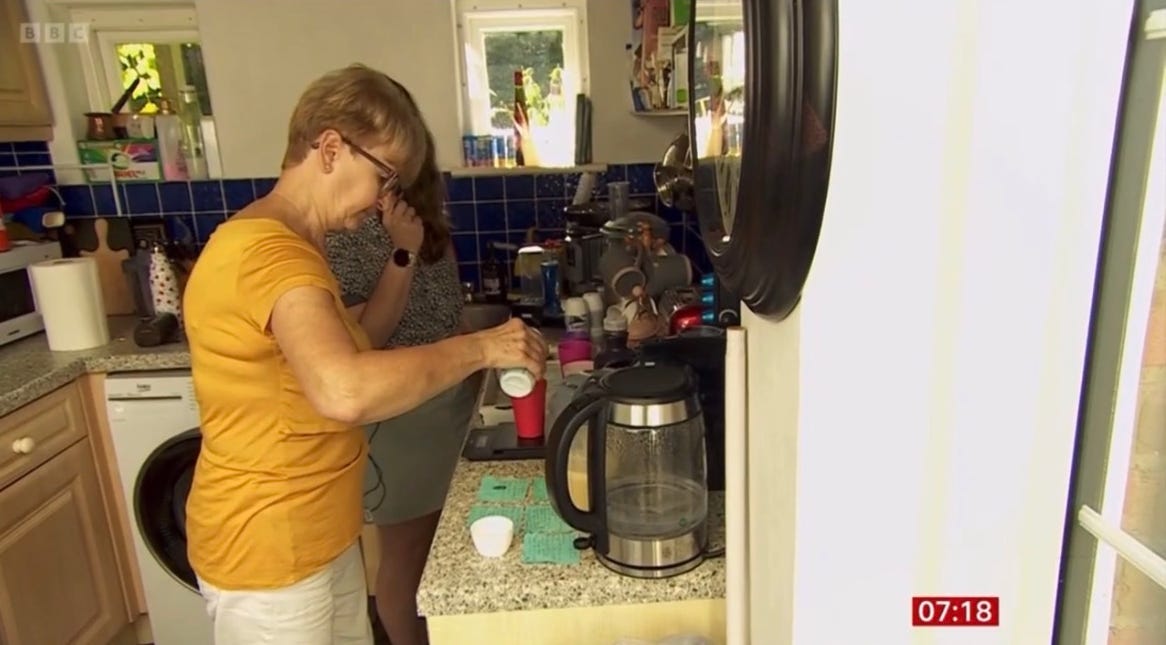
James needs someone on call 24/7 to help him meet his very basic needs. Given my own health difficulties – not to mention the fact that, aside from James’ disability benefits, my job is our only source of income – the only sustainable option has been to involve paid carers. Without them I’d be providing 24/7 care on my own with no respite.
Despite the severity of James’ needs, we’ve had to finance all of his care privately. James was assessed as ineligible for social care funding due to jointly owning a flat, which we could no longer live in due to his disability, but that we were for a long time unable to sell. Over the past two years we’ve spent tens of thousands of pounds on James’ care: his monthly care costs are currently twice our rent. It was my search for a way to cover these spiralling costs that eventually led me to apply for CHC funding. A simple solution it was not.
CHC funding
As the NHS puts it, CHC funding applies where “long-term complex health needs qualify for free health and social care arranged and funded solely by the NHS”. It is designed for those whose needs are particularly complex, intense and unpredictable. It can cover nursing, as well as the costs of wider care for patients meeting the CHC criteria.
In my opinion, it is an absolute no-brainer that people with very severe ME should – in almost every circumstance I can think of – qualify for CHC funding. Caring for someone with very severe ME involves managing risks and high levels of need across many of the CHC domains, from malnutrition and the risk of pressure sores to extreme challenges with mobility and communication.
Beyond this, the cardinal symptom of post exertional malaise (PEM) introduces high levels of complexity and intensity to all care interactions. When crashes can be triggered by things as innocuous as noise, smells or movement in a patient’s room, or minimal levels of touch, care is not easy to provide and in itself introduces significant risks. Such crashes can often be unpredictable, seeming to come out of nowhere, leading to a worsening of symptoms, an escalation of needs, a recalibration of care routines, and sometimes the need for emergency support. It is for this exact reason that the 2021 NICE Guideline recommends to “risk assess each interaction with a person with severe or very severe ME/CFS in advance to ensure its benefits will outweigh the risks”. Clearly, this does not imply standard risk management or care planning.
Our CHC battle
When I first came across CHC funding it felt like the perfect fit. James was finally assessed last March. I provided reams of evidence and sat with the multi-disciplinary team for hours explaining what caring for James involved. Their initial assessment concluded he was eligible. Yet, one year on both our CHC application and subsequent appeal have been rejected.
To put it mildly, the experience has been bruising. It has also left me thinking: in a context where the NHS is not equipped to provide James with any meaningful medical treatment, isn’t covering the costs of the care he needs to avoid further deterioration the very least they could do? Why is this one simple thing that could make our lives easier seemingly so hard for the NHS?
Some of the issues we have faced speak to wider challenges with CHC funding. A report last year from the Nuffield Trust found that the number of people found eligible for CHC had fallen over time, describing “concerns that financial pressures are playing a key role in the operation of CHC, with all parts of the system facing significant pressure to keep costs down”.
But there is no doubt in my mind that systemic failures in NHS care for people with ME also played a role. We started off the process at a disadvantage since, unlike most CHC applicants, we didn’t have an NHS specialist in our corner to provide evidence. Given a system where specialist NHS care for people with severe ME is “non-existent”, James is supported by a private specialist. Their detailed letter wasn’t referenced once in our Care Board’s rationale for refusing our appeal. Meanwhile, a low number of NHS interactions was used to evidence a lack of needs.
In my view, a lack of knowledge about ME has also been influential; in particular, a lack of understanding that PEM can lead to long-term deterioration (and has done on several occasions, in James’ case). This means that the risks involved in his care and the level of complexity have not been recognised, and nor has the extent of his limitations. Most difficult to read in our most recent rejection was a persistent framing of James’ needs as preferences: that he prefers not to verbalise and that he does not like having people in his room with him. Would they say someone with a severe nut allergy does not like peanut butter? That an asthmatic prefers not to breathe?
The bigger picture
I know that we are not alone in experiencing challenges with CHC funding. In our recent small survey of 17 carers for people with very severe ME, just four reported that the person they cared for was receiving support from a CHC-funded carer, and none received support from NHS-funded nursing. Almost as many (three respondents) reported covering the costs of carers from their private finances.
Let me be blunt: everything about how the NHS handles ME is broken. From the perspective of a patient and carer, everything is on fire. Achieving safe and meaningful NHS treatment for ME is a complex (and necessary) long-term goal. But don’t we need some quick solutions? Couldn’t easier access to CHC funding for those very severely affected be a much-needed quick win while we get on with the rest? I was surprised to find that the government’s Final Delivery Plan for ME doesn’t mention it once.
So, what next? This is an issue I’m keen to focus on in the coming months (if you’ve had similar challenges, we’re keen to hear from you). On a personal level, the fight goes on as we continue with our appeal to the next stage. I’ve recently managed to sell our flat, meaning that social care funding for James’ care may soon kick in. This may soften the personal impact, but it won’t cancel out how the NHS has, time and time again, proved unable to do the absolute minimum for patients with very severe ME.
In many ways, it’s been a painful reminder. The experiences James and I have had with CHC funding are exactly why we founded #ThereForME. They’ve also left me with a renewed sense of conviction: that we won’t stop fighting until the needs of people with ME – particularly those severely affected – are better recognised, understood and met.
Thank you for sharing this personal account - sending very best wishes for the next steps. You shine a light into dark places with insightfulness and professionalism. ThereForME brings hope and a breath of fresh air.
I’m so very sorry to read this Karen. I don’t know how you’re still standing after the battles you have had.
Ironically CHC funding is advertised on television making it look so easy to apply and get the assistance one requires.
I hope and pray that you can appeal this decision and receive the care that you both require.
Sending you both much love.
Fiona X