


Yesterday Andy Burnham, who previously served as Secretary of State for Health, and as Shadow Health Secretary in opposition, became our new Prime Minister. His government inherits the Final Delivery Plan for ME - and they will also inherit the problem this article describes. This week also marks one year since the Final Delivery Plan for ME was published. We’ll be reflecting on all of this - and #ThereForME’s second anniversary! - in a forthcoming blog post. In the meantime, we’re bringing you a piece from our co-founder Emma Gore-Lloyd.
When I speak to others about my partner’s illness, I am often asked: “How many people have ME?” It turns out that this is not a simple question to answer – googling it returns two wildly different figures, one three times bigger than the other.
Why does this matter?
Data on ME matters because numbers drive resources and political attention. If the number under-represents the scale of the issue, the response will be insufficient, affecting research funding, NHS service provision, social care planning, and benefits policy. Data also helps the government to understand economic impacts (a key driver for political attention, particularly at present); without a total prevalence number and more detailed data on how different demographics are affected, it’s hard to model this.

The data gap on ME is also indicative of deeper challenges. ME may not be being diagnosed accurately or consistently, and if ME diagnoses aren’t accurately recorded, then it’s harder for research, treatments, and care for people with ME to be prioritised or resourced appropriately. In addition, for those with ME, receiving a diagnosis can mean validation and support.
404,000 or 1.35 million?
The 404k figure (0.6% of the UK population) comes from a 2025 study by Professor Chris Ponting and Gemma Samms at the University of Edinburgh on access to ME diagnosis.
They looked at hospital and outpatient records of 62 million patients from 1989–2023 in England and found that 0.16% had the International Classification of Diseases G93.3 code for post-viral fatigue (this is the relevant code for myalgic encephalomyelitis). In reviewing the data, they found that access to diagnosis was patchy across England: Professor Ponting is quoted in a Guardian article as saying
“The NHS data shows that getting a diagnosis of ME/CFS in England is a lottery, depending on where you live and your ethnicity. There are nearly 200 GP practices – mostly in deprived areas of the country – that have no recorded ME/CFS patients at all.”
The study also found that Chinese, Asian and Black ethnic groups in the UK were significantly less likely to receive a diagnosis of ME than white groups. Taking uneven diagnosis into account, they modelled prevalence based on the best access to diagnosis, estimating a prevalence in the UK of 0.6%, or roughly 404,000. This is an update on the figure of 250,000 that had been used for many years previously.
(By comparison, the UK figures for those who have Alzheimer’s, or some other form of dementia, is around 1 million; 166,000 are estimated to have Parkinson’s; and at least 150,000 have MS.)
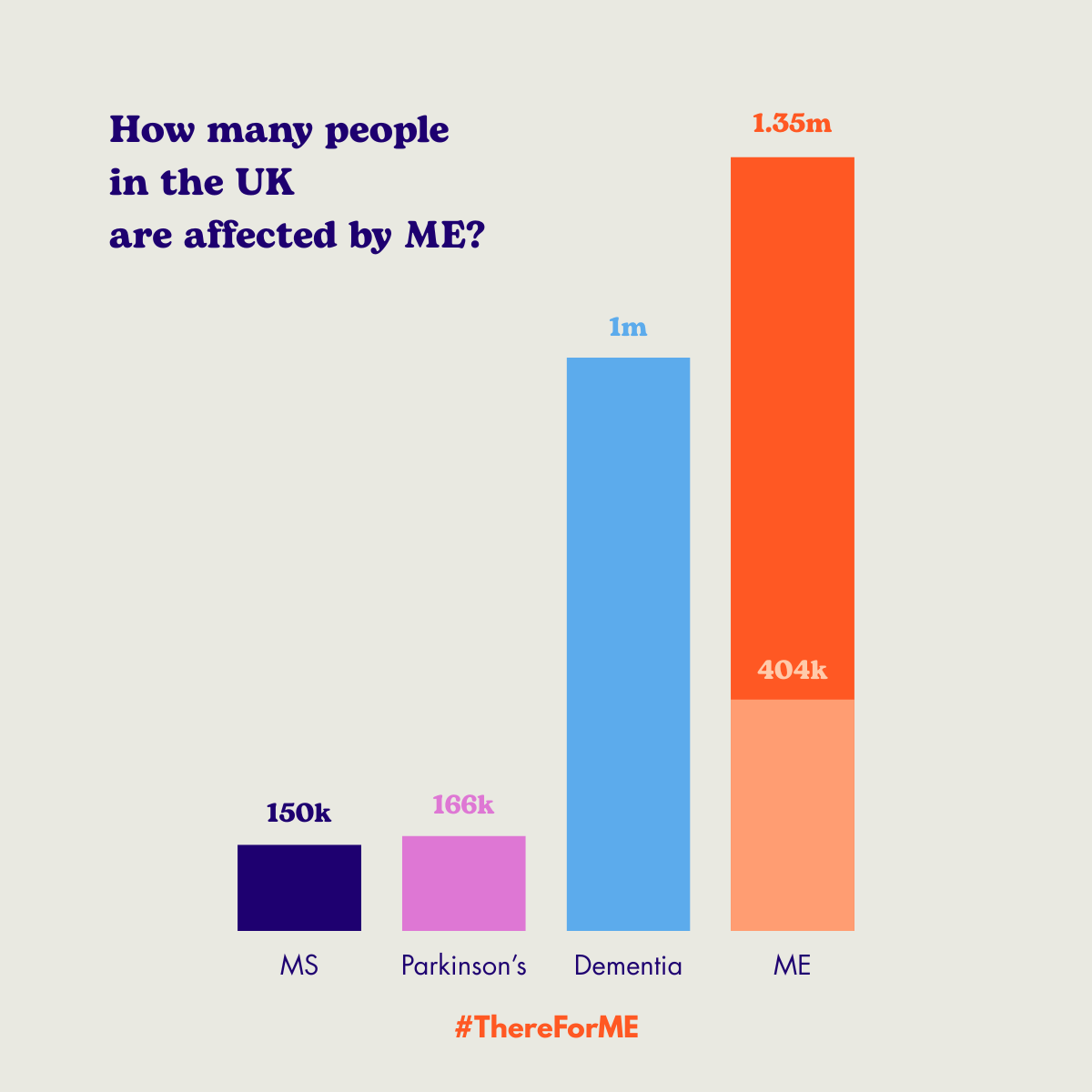
So why isn’t the 404,000 figure used universally? It’s not an actual headcount, but an estimate, which the authors describe as “lower bound”, because even in the best-diagnosing area there are people still waiting for a diagnosis. It is also based on hospital records, and therefore doesn’t include anyone whose code is on GP records only. In addition, Samms and Ponting’s study points out that, of the 0.16% who were recorded with ME, most had symptoms before the pandemic, and draws on a DecodeME study to show that those who became ill after Covid are rarely coded as having ME.
Charities and campaigners – including Action for ME, the ME Association, Forward ME, and #ThereForME (and Tessa Munt MP) – have instead chosen to use a higher 1.35 million figure. This aims to capture the significant number of people who developed symptoms meeting the diagnostic criteria for ME following Covid-19 infection. It is calculated from the above 404k plus the 50% of the 1.9m people in the UK with Long Covid who reported ME-like symptoms (based on 2023 ONS estimates, the most recent Long Covid estimate that exists for the UK as a whole).
While this figure may be less robust, we at #ThereForME have made the judgement that, by taking Long Covid into account, it reflects a better estimate of the true scale of the issue. The difference is not small: taking ME-like Long Covid into account gives us a figure roughly three times as high as the 404k figure, and equivalent to around 1.9% of the UK population, or more than the population of Birmingham. We feel this is a better basis for policy making, rather than leaving nearly a million people uncounted.
How many of those are very severely affected?
The Final Delivery Plan committed to explore commissioning a specialised service for very severe ME. As regular readers will know, this is an issue #ThereForME is looking at closely.
The figure generally used to say how many diagnosed with ME have severe or very severe ME is 25% – again, it’s an estimate, but we don’t have high quality data on how many of those are very severely affected to draw on yet.
A new SNOMED code (used by GPs to record clinical information) for very severe ME was introduced in May 2026. This is welcome progress, but only if GPs are supported in using it accurately.
To add to the confusion, there are a variety of functional ability scales and clinical severity descriptors, but currently no shared definition of “very severe ME”. For example, compare these two descriptors:
NG206’s clinical descriptor:
“People with very severe ME/CFS are in bed all day and dependent on care. They need help with personal hygiene and eating, and are very sensitive to sensory stimuli. Some people may not be able to swallow and may need to be tube fed.”
Action For ME’s functional ability scale defines “very severe ME” as being able to do 0-10% of what was possible before becoming ill. It describes 10% as:
“VERY SEVERELY AFFECTED Severe symptoms following any activity. Weakness or pains in arms and legs. In bed most of the time but feeling more stable and less dizzy. No travel outside the house. Concentration very difficult. A friend can be seen for 10 minutes or so.”
Forward ME has been looking closely at this – led by Dr Charles Shepherd from the ME Association – with the aim of providing the Department for Health and Social Care with a clearer definition of very severe ME.
Why are we still estimating?
There are a few possible reasons, including lack of familiarity with ME, overlapping conditions, and more systemic issues.
Lack of awareness in healthcare means that GPs may not be aware of ME or confident in diagnosing it. A recent FOI request by Lucibee showed that the NHS e-learning module “An Introduction to ME/CFS on ME” (published in 2024) has been accessed 576 times by NHS email accounts and completed only 293 times. The other modules, published later, have much lower access numbers. These modules are not mandatory and do not offer CPD points to those who complete them. Similarly, lack of public awareness means that some with ME-like symptoms may not know to ask their doctor about it.
Those who have conditions which have very similar or overlapping symptoms with ME may also not receive an ME diagnosis. Long Covid is the obvious one, as mentioned above, but Lyme disease and concussion are also cited as triggering ME, though there isn’t clear agreement on this. Having spent time in a post-concussion forum (for myself) and a chronic Lyme disease forum (for my partner), I see a lot of people talking about ME-like symptoms, but not much mention of ME or ME diagnosis.
Finally, the more systemic issues. Strikingly little has been invested in research, which might explain why there haven’t been more prevalence studies. Given the historical stigma surrounding the illness, some people with ME may avoid healthcare or be too ill to access it, remaining invisible in official statistics. The lack of concrete data is a symptom of this neglect, and it also sustains it.
What’s the solution?
ME charities and advocates – including #ThereForME – need to do our best with the data we have, including being transparent about the trade-offs that are involved in using the various statistics on offer. We also have a role to play advocating for investment in the infrastructure needed to improve the data, such as training and research.
Clinicians and researchers must set a clear standard on the criteria used in diagnosis and research and demand consistent use. Medical professionals should ensure they undertake the appropriate training available and code ME accurately.
The UK government should invest in prevalence studies to make the most of the data that is available, and use this information to inform future policy on funding, healthcare and benefits.
Millions of lives changed beyond recognition
Beyond this, we will continue to advocate for the government to recognise the full extent of the issue. Speaking in the House of Lords, Baroness Scott of Needham Market spoke recently about the “lives changed beyond recognition” by ME. These include not only those with ME themselves, but also their family and friends. Personally, I can count at least four lives heavily affected by my partner’s very severe ME.
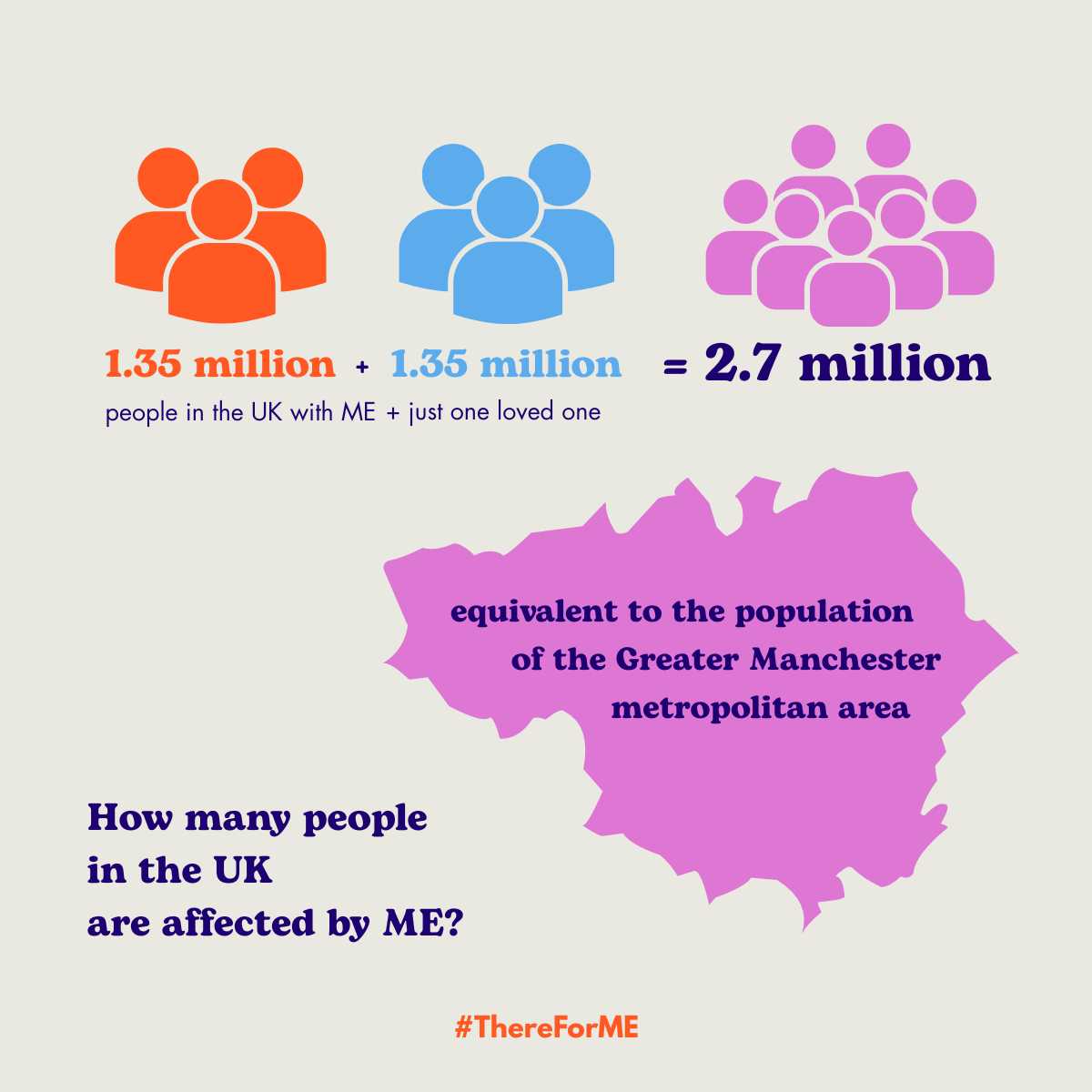
If you start from the 1.35 million figure and count just one additional person whose life is affected by someone they love having ME – by becoming a carer, for example, or managing a family or finances alone – the number of those affected by ME doubles to 2.7 million, equivalent to nearly 4% of the UK population, or the population of the Greater Manchester metropolitan area. Perhaps of interest to one particular former mayor?
How many people in the UK are affected by ME? We don’t have an exact number but we do know that, when family and friends are included, whichever statistic you’re using, it’s millions. This in itself should be a call to action. This is a population that shouldn’t be left behind while we’re waiting for the data to catch up.
Thanks Emma for such a clear & objective overview.
Do you know if anyone has, or is developing, a screening tool for ME/CFS or maybe for PEM/PESE as a starting point for a prospective prevalence study (as opposed to relying on diagnostic codes)?
I guess the inclusion/exclusion criteria for current clinical research studies would be a starting point if not (I recognise it’s not straightforward).
Also - as one of the 2.7+million people who ‘know’ ME from the outside (sister, daughter, niece, colleagues), l was wondering if it’s possible to create an educational package that WE could personally deliver to GP practices in our own areas to raise awareness - a sort of ‘how much do you know about ME/CFS?’ prior to a prevalence study - maybe entitled ‘do you know how many patients in your practice have ME/CFS?’
Has anyone tried to register the online education package for CPD points? We used to run a Research Skills course (hospital based) and that had CPD points from the Royal College of Physicians. Maybe a carer/patient led education program could then highlight the clinical training course.
Sorry if this is a bit rambling - as a retired clinical research manager, whose daughter has severe ME, l’d like to do more to further ME awareness & especially research but struggle to know how best to do this.
I don’t know how many people have ever recovered fully. In the first year if someone arrests it and spends the second year recovering, maybe they get back to something near their original capacity, but how many of these people are as healthy and robust as before? I don’t think any are. Some studies have stated that after the first year, recovery probability is in the single digits.
Another matter is of course the lack of awareness and support for people with ME. Action for ME will do more to help sufferers and their families but seems to have less funding and almost no staff at present. I believe they need extra financial support right now but I am not their representative to say that. ME Assoc. seems only able to signpost over the phone, generally. If there were ever enough money, it would help to run an ad campaign explaining what ME is and how badly it affects people and why we know it is not psychogenic.
Even post-concussion syndrome becomes very similar to ME because it follows a similar feedback loop of inflammatory damage causing a cascade of neuro chemical and hormonal changes and changes to soft tissue structures which makes blood and lymph flow impaired.
The postcode lottery aspect to being diagnosed and advised (there is no treatment) for ME is simply unacceptable. In my area the local services have shuttered as well as in the neighbouring county.