


In September, Prime Minister Andy Burnham used his speech at the Labour Party conference to announce plans to create a national care service in England. Social care for people with ME and Long Covid is an issue ThereForME and our partner organisations have recently been focusing on. Following our previous post, which shared several experiences from across the UK, today we are sharing three more, from Northern Ireland and England.
Living with severe ME in Northern Ireland – Aileen McCullough
Aileen McCullough is a mother of two living with severe ME in Northern Ireland. She has volunteered with Hope 4 ME & Fibro Northern Ireland for over 15 years, whenever her health has allowed, and her two sons now also support the charity’s awareness-raising work.

I am 43 and a parent with two children. I have severe ME, which has left me largely confined to a hospital bed, living in a darkened room and only able to leave home for urgent medical appointments (travelling by ambulance, on a stretcher). I depend on others for the simplest things that most people never have to think about: preparing food and drinks, washing, dressing, catheter care and medication. Yet I receive just three hours and 20 minutes of funded care each day. When that support isn’t available, I am left without help for essential needs. Severe ME not only takes away health and quality of life; without appropriate support, it also takes away independence, ordinary family life and the ability to participate in society.
My care involves input from my GP, district nurses, occupational therapists, speech and language therapists, social workers and other services. None of these exists in isolation, yet there is often nobody responsible for bringing them together. Instead, people with severe ME are left trying to coordinate complex care themselves, despite being among those least able to do so. When you receive just over three hours of care each day, coordinated support is not a luxury – it is essential.
The consequences of inadequate care assessments
Despite repeated requests from paid carers, I still have no safe way to get out of bed independently or use the toilet. Without professionals who understand severe ME, assessments can fail to identify even the most basic support needs. When appropriate assessment and support are lacking, health, dignity and independence are compromised. There is no additional support or safety net in Northern Ireland, which particularly affects those without family to fill the gaps left by inadequate services or limited care hours.
The impact extends far beyond personal care. Without the right equipment or support, I cannot safely spend time with my family outside my bedroom. Even something as ordinary as spending time with my family on a bed in the living room and returning safely to my bedroom is out of reach. Moments like these are not luxuries; they are a part of family life that many people take for granted. Good care should not simply meet basic physical needs; it should also enable people to remain part of family life wherever possible – a basic human right.
Barriers to coordinated care in Northern Ireland
Although the 2021 NICE guideline for ME/CFS sets out how people should be cared for, its recommendations have not been consistently implemented in Northern Ireland. Unlike people in England, those of us living in Northern Ireland are not covered by the Care Act 2014. Due to the absence of a specialist ME service and a lack of trained professionals, many struggle to access informed, coordinated care and appropriate support.
The challenge is not the absence of training, but that it is not compulsory for staff working with people with severe ME, and that knowledge of the condition is not consistently embedded in routine professional practice across services. There are General Practice Northern Ireland (GPNI) learning resources on ME for health professionals and free continuing professional development (CPD)-accredited education provided by Hope 4 ME & Fibro Northern Ireland.
People with severe ME do not simply need more services. We need existing services to work together, with professionals who understand the illness and someone taking responsibility for coordinating care. No one with severe ME should be expected to manage a complex system that cannot even coordinate itself.
Contributions to care – Hannah Avery
Hannah Avery, 24, has had varying levels of ME since she was 13, mainly at the severe end of the spectrum. For seven of those 11 years she has used social care to access support from paid carers.

ME is a widely misunderstood condition. It causes suffering that is hard to capture in words; as patients, we are trapped in our homes and beds, unseen and unsupported. The loss of independence is just one of many traumas that sufferers face, and it can bring about increased levels of hardship.
When you are too sick to look after yourself, you need full-time care. When your family cannot take care of you 24/7, you need paid carers. If you cannot afford to pay for carers, you can apply for social care from your local authority. If you are lucky enough to be believed and they assess that you need help, you are expected to contribute towards the cost of your care, unless your total income and savings are below a financial threshold.
Disability-related expenditure can be offset against contributions, helping to reduce them. I have dutifully kept track of the money I spend on disability-related costs, which over the past three years have come to around £2,500 a year. Examples include a blood-pressure machine, a subscription to a heart-rate pacing app, electrolytes, hot-water bottles, wheelchair servicing, an adjustable bed, extra laundry costs, work to make flooring flat to improve mobility, air-conditioning costs and private healthcare fees. However, it is up to financial assessors to decide what counts as disability-related expenditure, and in my case private healthcare was seen “as a choice of treatment on top of the NHS services and so to be paid for by the service user”.
A lack of awareness of how underfunded and under-supported patients with ME are means that my private healthcare treatments are seen as a choice rather than a need. In 2021, I was 100% bed-bound in a dark, soundproofed room, requiring round-the-clock care for feeding, toileting, bed-bathing and anything else needed to stay alive. The NHS offered me nothing but pressure to engage in cognitive behavioural therapy (CBT) and graded exercise therapy (GET). My private consultant, an ME specialist, prescribed me an off-label treatment that was not available through the NHS. A year later, I could tolerate daylight and weight-bear; my social care package was reduced from over 100 hours a week to around 20 hours.
I have saved my local authority thousands of pounds by investing my money in private healthcare. Yet none of these investments are counted as disability-related expenditure. The financial assessor from my local authority recently determined that I needed to contribute £27.47 to my care each week. If this year’s private healthcare costs had been counted, I would not be contributing anything. The NHS is decades behind on funding, research, support and pathways for people with ME. At the very least, private healthcare costs need to be acknowledged by social care as valid disability-related expenditure.
How do you arrange safe social care for someone with very severe ME? – Karen Hargrave
Karen Hargrave is co-founder of ThereForME. She has ME and is also carer to her husband James, who lives with very severe ME.
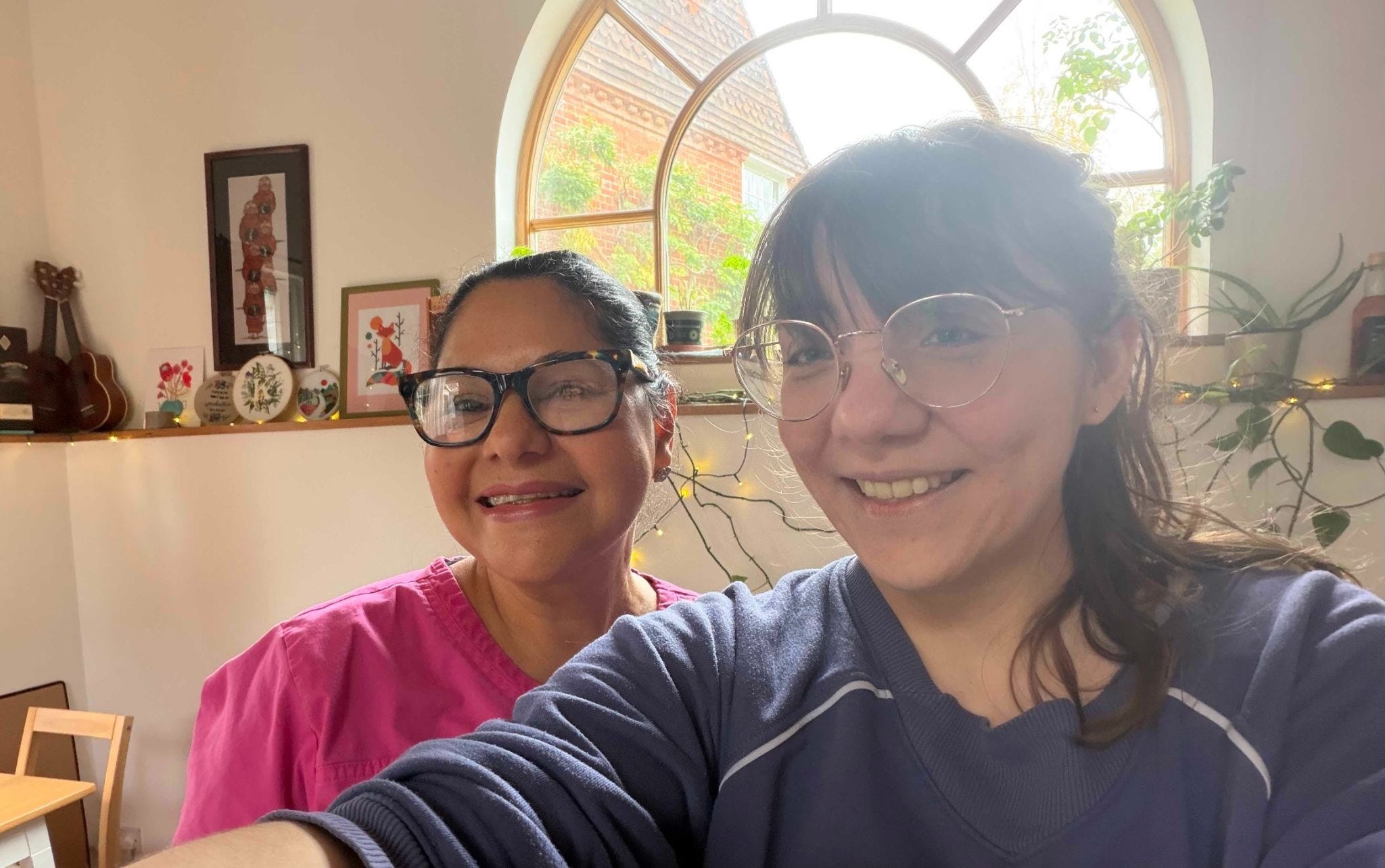
Over the past few years, I’ve spent a lot of time fighting for funding for the care James needs to live safely and with dignity. He was denied NHS Continuing Healthcare (CHC) funding, but, following a change in his financial situation, became eligible for funded adult social care earlier this year. After months of negotiation, we were finally awarded an adequate care package. However, the difficulties don’t end there: once you have a package of care, how do you go about arranging safe and appropriate care for someone with very severe ME?
Organising and recruiting carers
We have chosen to receive our care package in the form of direct payments. This means you arrange the care yourself and pay for it using a pre-paid account provided by the local authority. This option comes with a lot of admin, but it means we can select carers who are the best fit for James’ specific needs and ensure his care is consistent.
We have had support from paid carers for about two and a half years (initially self-funded), and during that time I’ve recruited six carers. We’ve currently got two amazing carers, but it’s been hard work finding the right people for the job. Not every carer will be a good fit for someone with very severe ME. Symptoms such as extreme sensitivities to noise, light, movement and smell can rule out many who aren’t able to adapt their work to these parameters: some may not be comfortable giving up perfume on their working days or working in a darkened environment, and others might be better suited to roles where they can chat with their clients. Over time I’ve learned that it is best to be upfront about these parts of the job, and to invite potential carers to do trial days to get a feel for what these symptoms mean in practice.
Plugging holes in a broken system
I find it remarkable that, of the many carers I’ve spoken to, not one has had experience with ME or any training on the condition. Instead, I’ve looked for people who are open and willing to learn. I have found the new NHS e-learning on severe ME helpful for giving new carers a basic understanding of what to expect. Still, it is no substitute for more detailed training and guidance, which falls to me and now, thankfully, also to one of our longer-term carers.
I am often left feeling that we are plugging holes in a broken system. There’s no in-depth course I can send our carers on, beyond the basic e-learning modules, and no expert care agency to turn to. The responsibility to get the right care for James is huge, and I often think of those who don’t have someone to organise their care and train their carers. There is no way James could do any of this for himself, and, frankly, why should he have to? People with ME need support from a social care system that fully understands their needs, as well as how to safely meet them.
Thank you to those who have used precious time and energy to speak up about the shocking reality of the lack of understanding of this condition among those who make crucial decisions that affect patients' lives. I am fortunate to have sufficient capacity to function with family support and careful pacing and my heart breaks for those who desperately need help and are repeatedly denied the support that might give them access to basic dignity and human connection. The lack of knowledge of and education about ME is an outrage. Thank you for all your campaigning efforts.